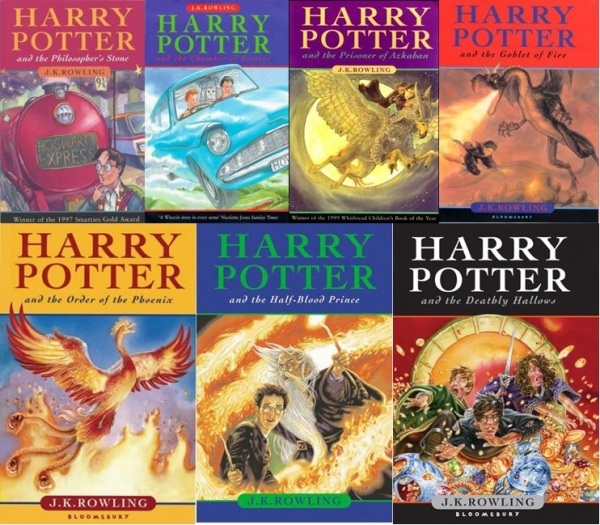
The Harry Potter books and movies have been loved and cherished for around two decades. It was a series that was recognizable to millions of people, to the point so that some of the advertising for Deathly Hallows Part Two didn’t even name the title of the movie. It has also led to the opening of Harry Potter World in both Universal Studios locations (Orlando, Los Angeles), with hundreds of thousands flocking to partake in some of the magic. The Harry Potter series was classified as the hallmark of an entire generation.
While the fandom for Harry Potter seems to be thriving, I can’t help but wonder how much this is done out of pure nostalgia, especially as more negative light turns to the series’ author, J.K. Rowling. As time goes on, I notice that former die-hard fanatics are noticing more issues with the series, particularly with the actual lack of originality that the magic world in the series has. But contrasting from these fans-turned critics are the ones that are still die-hard, constantly taking every house quiz, referencing the series when they can, and even getting permanent tattoos of famous symbols. It’s an interesting mix that I increasingly notice is coming at odds with one another.
In order to analyze why I notice some people being pushed away, we’d have to first look at the history of negative light placed on the author. You see, this all started after the release of Halfblood Prince (the book, of course), in which J.K. Rowling announced that Dumbledore, the father figure to Harry Potter, was actually gay. This came at a celebration of diversity initially, although there were some that questioned the fact that Dumbledore never revealed anything about his sexuality (no reference, no actions, nothing) in either the books or the films. Over time, this move turned purely to criticism, calling the author out for making a cheap shot of queerbaiting, especially with the lack of interaction between Dumbledore and his supposed “lover” in Fantastic Beasts and Where to Find Them 2.
J.K. Rowling only put more bad attention on herself by claiming diversity in the books after the fact, despite never referencing those characters in her series. This gained more negative attention and criticism, although a meme has arisen around her after-the-fact claims, with people claiming ridiculous things to mock her attempts.
Now, you may think “well, she wrote the books in the 1990’s and early 2000’s, she’s from England, so it would make sense that she’d only write about white people”. There’s a few issues with that logic. She had written the books with only white people, which, if you just left it at that, is fine. There’s nothing wrong with admitting that most of the characters are white, and all of them are straight. Most mainstream series and books from that period were like that (especially European books, although they do have a level of diversity that they seem to ignore). If she had just acknowledged that fact, there wouldn’t have been any controversy. But to try and say that you had diversity, while not putting in the effort to display that diversity, or re-editing the books to show real difference, is just weak. It reads as cowardice and band wagoning, which would turn people away.
Another issue, which came up earlier this year, is that J.K. Rowling has been following and liking the posts of TERFs. What is a TERF? A TERF, or Trans-Exclusionary Radical Feminist, is someone that focuses on promoting the equality of “biological” females, claiming that trans-males are traitors and trans-females are women-haters. They claim to be feminist, but are really not, and they are rejected by most of the feminist community, leading them to call discrimination and brainwashing. Their tweets are very difficult not to tell, and J.K. Rowling liked and retweeted several from a known TERF, which were targeted against trans-females. This caused some outrage, but not nearly as much as it should have. In fact, it has almost been completely forgotten, quickly hidden with news of a new interactive Harry Potter game. But it left its mark on me.
Where do I sit on this issue? Well, I was never able to finish the original series, despite the fact that my sister had read all seven books 4 times. I saw the movies, but was never all that invested. But the controversy has made me quite put off from investing my time and money in any of J.K. Rowling’s works or films.
 Pop N' Crunch