It’s no surprise that when Disney does a retelling of a classic fairy tale, they definitely make it more “kid-friendly”. The once morally imbued and rather dark stories have found themselves remembered as sweet and innocent tales, one of happily ever afters and all the like. But what are the original tales? How were they in their most original form, and how has Disney mellowed them out?
I think to answer that, we have to look at the oldest Disney feature length film, Snow White. Much of the first part of the film follows that of the German story- the Queen is vain, and tries to kill Snow White when she surpasses her in beauty. But rather than telling the Huntsmen to retrieve her liver and lung, the Queen instead asks for her heart.
From then on in the story, Snow White still goes to the house of the seven dwarves to live there. But rather than try to get rid of Snow White once, the Queen actually attempts to kill her three times: first with lace, then with a poisoned comb, and finally with a poisoned apple. When Snow White is in a death-like state, the Prince stumbles upon her glass coffin (that the dwarves had placed her in rather than let her be buried in the ground), and immediately falls in love with her appearance. He persuades the dwarves to let him take her coffin so that he could look at her, and as his men lift her coffin, the piece of apple she had bitten falls out of her mouth. She wakes up, and they decide to get married, inviting the Evil Queen. The Queen, not knowing that the other queen was Snow White, attends the wedding, and is forced to dance on hot coals until she drops dead.
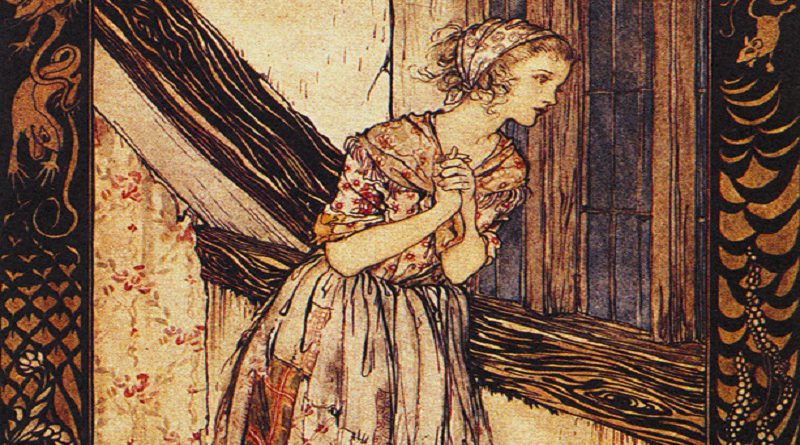
The next big fairy tale comes from the french original of Cinderella, also documented by the Grimm brothers. In this book the father never disappears, but is complacent in letting his second wife and stepdaughters turn Cinderella into a house servant. She works all day and all nice, cleaning the fire place, and doing other chores, and must sleep next to the fireplace at night, covering herself in ash and dust. She was given the name Cinderella, as a way to taunt her. Everyday she goes to her mother’s grave and weeps, and finds that a white dove hangs above her grave, granting her wishes.
On the dawn of the festival that the Prince was hosting, the stepmother forbid Cinderella from attending the ball, insisting that she was too dirty and embarrassing. Cinderella went to her mother’s grave and wept, calling on the bird to throw gold and silver down upon her. For three days she called upon the bird to dress her extravagantly, attending the ball and gaining the sole attention of the Prince. She keeps evading the Prince so that she couldn’t be recognized, but on the third night, the Prince had set a trap, causing her to lose one of her (golden) shoes.
The Prince decides to use the shoe to find her, and goes to the house of the Evil Stepsisters. They both try on the shoe, the older one cutting off her big toe and the younger one cutting off her heel to fit in the shoe. The Prince initially takes each one, only to be turned around by birds. Finally, despite the protest of her family, the Prince places the shoe on Cinderella, and realizes it’s her. They host a wedding, and the Evile Stepsisters try to go to Cinderella to gain her favor, only to have their eyes poked out by pigeons.
The third classic fairy tale I’m going to talk about is Sleeping Beauty, or Sun, Moon, and Talia. In the story, there is no slighted fairy (that would come in later versions), but rather a horoscope cast that she would face danger at a spinning flax. Aurora (or in this case, Talia), finds an old woman spinning as a teenager and asks to be taught how to spin. She gets the flax trapped in her thumb, and falls into a deep slumber, one that she cannot be woken up from.
She is left in the palace seemingly abandoned but attended by fairies, when one day a King stumbles upon the palace while on a hunt. He climbs a latter into her room, and is stunned by her beauty. After trying to wake her initially (unsuccessfully), he decides rather to rape her and be on his way, forgetting about her. Nine months later Talia gives birth to twins in her sleep, one boy and one girl. One of the children, trying to find her breast, actually sucks on her thumb, sucking the flax out and waking Talia up.
Not long later the King comes to see her again, and is joyous at finding her awake and with children. They fall in love after a few days, and he leaves again, promising to take her and the children with him next time.
The King’s first wife, realizing what has happened, plots to have Talia and the children killed, but is ultimately unsuccessful. She had ordered the twins to be cooked up and served to the king, but the chef, being kind-hearted, keeps them alive. She also tries to have Talia burned alive. But the king appears just in time and has his wife burned alive instead, marrying Talia and living with the children.

 Pop N' Crunch