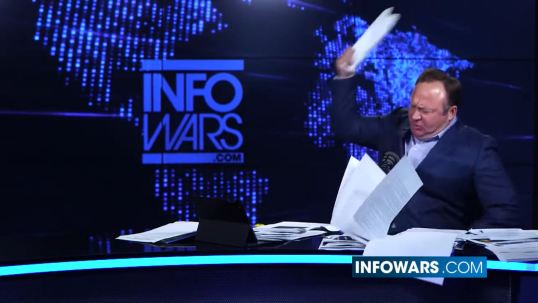
Social Media Bandwagon: The Case of Alex Jones

Within the last few days, Spotify, Facebook, Youtube, and Apple all made the move to ban Alex Jones, the runner of the conspiracy theory podcast known as Infowars. Apple was the first to make the move, with two days later the other three platforms following suit. This came as a result of months of complaining from general populace, who wanted Alex Jones banned for promoting false information and dangerous lies. And while this is a step in the right direction, it comes in a way that seems cowardly.

But let’s start at the beginning. Why did people want Infowars banned? Initially seen as a funny meme in the beginning, the podcast was quickly recognized as dangerous, spreading misinformation and promoting distrust in real media, arguing that the conspiracy theories presented are actually true. This grew dangerous under the age of “Fake News”, causing people to follow him and believe him, further dividing people over what is actually happening in the country.

This caused people to start pushing to get him off of mainstream social media platforms. People were tired of Alex Jones and his podcast, and wanted him to stop having open access to unsuspecting audiences. People even cited that he was breaking terms of service on multiple platforms in order to try and get him off the normal way, but none of the social media platforms did anything. Despite constant protest and pushing to get him off, not a single platform did anything.

That was, until Apple finally decided to cut his app off, and to stop streaming his podcast on Apple Music. Then, seemingly out of nowhere, the other three platforms “found’ that Jones was in fact breaking Terms of Service. Now he’s only on Twitter, saying that the other platforms banned him out of cowardice. The real case is, however, that no one wanted to do anything unless someone else did it first.

Think about it. As good a move as it is, why did it take so long for the platforms to act? Then, when Apple finally banned Jones, why did they move so quickly? Because they’re jumping on the bandwagon.

The thing is, companies don’t really care, unless it will hurt their own public image. So when a big company like Apple moves, of course Facebook (who recently took a major hit over selling information and causing a company to make bot accounts), would want to jump at the opportunity to make themselves look better. And of course Youtube and Spotify would want to as well, in order to prevent losing public face. It does make them look kind of weak.

But at least they did something good. I can’t hate on them too hard, because it wasn’t like they banned someone people actually liked. But it does kind of look sad when companies jump on a bandwagon to keep people on their platform.

“Let’s Make a Podcast”: the New “Let’s Start a Band”

In the decades before, particularly in the 1970s through the 1990s, the common movie phrase among young rebellious teenagers is “Let’s start a band.” This phrase even made appearances into the early-to-mid 2000s, when teenagers wanted to become famous and popular, fast. It was inspired by regular young teen’s desires to become famous their own way, but in the case of the movies they were always successful.

But now no one uses that phrase anymore. Now the new in thing is the say “Let’s start a podcast.”

Why a podcast? Beats me. Maybe it’s the idea of people just sitting, relaxing, and talking about a random subject for an hour while making a profit. Maybe, people think it might be an easier and more sociable way of gaining media influence than Youtube. Or perhaps it’s just a creative outlet that some people want to take. Whatever the appeal is, podcasting is attracting a lot of people.

Podcasts are appearing all over the place, on many platforms. Spotify even has a special category just for popular playlists, something that I hadn’t seen two years before. What once was a more niche source of entertainment is now extremely popular. I’ve even been recommended a nice podcast to listen to while driving five hours home. I haven’t tried it yet, but the fact that I was recommended it says something.

No one wants to be in a band anymore (except for the more hipster bands). Most mainstream artists these days are solo, with the occasional band in between. Wanting to start a band has seriously dropped in popularity, especially among the young kids who now dream of becoming Youtubers. Starting a podcast seems much more achievable and appealing. You can talk about seemingly any topic in the world, making itself an auditory form of blogging. I’ve heard podcasts about different serial killers, new movies, or just funny story times and games. They can be quite soothing. There’s a a larger band of creative freedom when it comes to podcasts, although there can be quite a bit of freedom with starting a band in this day and age as well.

There’s nothing wrong with starting a podcast. You certainly don’t need to know how to play an instrument to start one (although showing off your skills on it might be entertaining). But that isn’t to say you can just start out of the blue. It’s recommended that you have at least some tech experience editing audio and video, and dealing with sound recording. Not to say that you need to be an expert, but being a total newbie to it can make it quite confusing.

How Kpop got its Place in Western Media

Now that the season of music and movies has hit, Spotify has begun releasing a weekly playlist called “New Music Fridays”. I’ll listen to it sometimes to find music to add to my own personal playlists, and am unsurprised with the typical English and Latin music that comes on.

Today was different, however. Today I was pleasantly surprised to hear Blackpink’s “Ddu-Du Ddu-Du”, which had been released today (along with the music video for it). Blackpink is a prominent girl’s Kpop group, whose song “Boombayah” had broken records for being the most viewed debut song on Youtube, and achieving 150 million views in less than six months. Even as I write this, the music video “Ddu-Du Ddu-Du” became the fastest girl group Kpop music video to hit 10 million views. To hear their newest song on a playlist of otherwise Western songs was interesting.

The song (which was pretty good, by the way) got me thinking about Kpop as a whole. Just six years ago, most people outside my neighborhood (I grew up in a Korean neighborhood) had never heard of Kpop. Now, advertisements featuring BTS (the most popular Kpop group of right now) are growing increasingly less uncommon, and just about everyone I’ve spoken too knows about Kpop. This did not happen for no reason.

No, the reason Kpop has burst on to the scene goes beyond the accidental popularity of “Gangnam Style”. South Korea’s entertainment industry sits in an interesting situation, receiving direct funding and advisement from the Korean government while at the same time holding themselves as a private industry. This is because while the South Korean government is promoting a market economy with both a private and public sector, they are promoting it in a way that gives them control over how they promote the nation’s image. They want Kpop and Kdramas to spread and show how “cool” of a country South Korea is. The goal is to have their pop culture be known not only in Eastern and Western markets, but also in what’s called “developing” markets as well.

With the massive amount of funding the entertainment companies receive, they can push out higher quality media, to the levels of Japanese and Western media. They promote a Western appeal (adding rap, street wear), while at the same time keeping a unique flair that is inherent to Korean media. They were trying to make their brand known.

But even with all the effort put in, many were shocked to find that “Gangnam Style”, a lyrical satire about the Beverly Hills of South Korea, took the cake for breaking into Western markets. The song, which makes fun of the mannerisms of the rich in South Korea, was not the song the government wanted to be the first Kpop song that new audiences heard on a large scale. While that isn’t to say that they didn’t want singer Psy to make the song at all (he was a relatively popular artist within South Korea), they certainly didn’t want it to become that popular. But not everything can go according the plan, however.

I can’t say “Gangnam Style” was the song that put Kpop in the spot it holds today.  It seems more like the genre gained a more permanent footing when BTS shocked audiences by snatching the title of Top Social Artist at the American Billboard Awards in 2017, beating out prominent names like Selena Gomez and Justin Bieber. It sent the internet ablaze, being divided between fans who were excited for the win, and quite a few people who were asking “who are these guys?”. And while Kpop was popular already, I felt it opened more people to exposure from Kpop, getting more people to jump on the “Korean Craze”.