The Downfall of Greek Myths in Movies

Greek mythology often finds itself in the spotlight of Hollywood films. Usually avoiding the Odyssey, Jason and the Argonauts and Persesus are the most commonly found, although differing interpretations on Greek mythology, like the Percy Jackson movies (although we don’t speak of those), do make appearances.

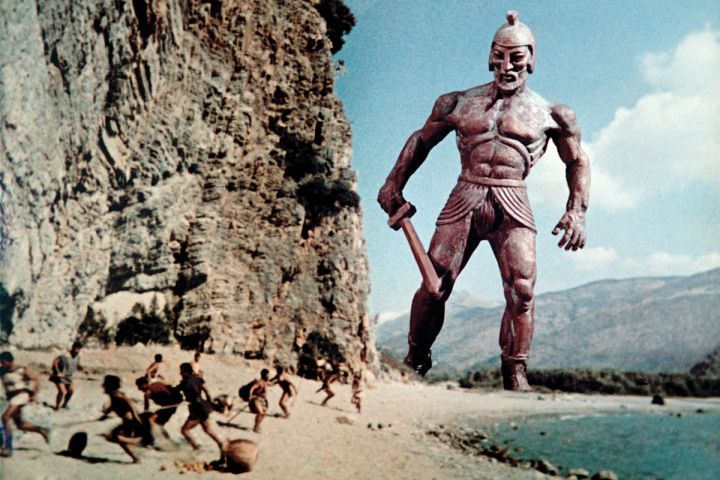
Turning Greek myths into movies found its height from the 1960’s to the 1980’s, when claymation monsters dominated the screen rather than advanced CGI. I can’t knock the use of claymation, however- filmmakers got creative with it, and were able to make it work fairly well. As comical as they look to audiences nowadays, you have to admit that for their time, they were genius moves.

Now, however, Hollywood has lost its way when it comes to showing off the legendary epics. What used to be just portraying the tales as is (with some creative difference, but not much), is now a strange and unsuccessful attempt to make the stories more “original”. They use an excessive amount of CGI, turning the classic mischievous and playful Greek gods into serious and dramatic figures, erasing some of their most bizarre origins and reactions. The myths portray the Greek Gods as divine and powerful but characteristically flawed (they are perfect at something, hence their God status). Movies now simply turn them into perfect but overly angry figures, exaggerating their temperamental behavior.

The legendary figures also find themselves changed, too, turning figures like Jason and Perseus into gritty and dramatic figures, when they show a variety of behavior, portraying a story of morality on a complex hero. In modern movies they are now meant to fight these giant monsters, getting girl while playing a one-note tune of being a one-dimensional hero. The main hero finds himself enveloped under the fold of the typical cliche action hero, completely ruining the point of the original Greek Epic or legend that they appear in.

The aesthetic of the new Greek myth movies also are much darker. Rather than being more realistic of showing an environment like daytime Greece, they show changing skies and darker backgrounds, making the story seem much less real. Of course, they are portraying stories, but compare them to their predecessors; compare the sky, the backdrop, and most importantly, the clothes. The cloths all look Spartan based, rather than showing the diversity of Ancient Greece (which wasn’t a unified country). It all makes seeing the Greek myths on screen that much less popular.
The Popular Myth of July and August

There is a common myth that Julius Caesar and Octavian Augustus added the months of July and August, respectively. But there’s a reason that myth never makes an appearance in any popular culture surrounding the two men: because it’s a myth.

Well, it’s not entirely a myth. But I will get into that later. You see, the months that were added to the calendar that we use today were actually January and February, with February originally being placed at the end of the month. This is thanks to the Roman ruler Numa Pompilius (a Roman king), who decided to make the calendar longer after realizing that the calendar was far too short to make up for the actual year. This comes as a result of the original Roman calendar, which was merely taken from it’s lunar Greek predecessor, was only 304 days long. When Numa added the two months, the calendar got pushed up to 355 days, eliminating the need for adding an extra month(s) just to play catch-up to the rotation of the sun.

So, if January and February were actually the months that were added, where did July and August come from? Well, Before the dictator and emperor came in, the calendar looked like this: January, Martius, Aprilis, Maius, Juniius, Quintilis, Sextilis, September, October, November, December, and February. Can you see which ones were changed? Well, Quintilis wouldn’t be changed until after Julius Caesar’s death. As a part of his divination by the people, Augustus changed the month of Quintilis (which means fifth in Latin) to July, in honor of Caesar’s birth month.

August, however, would be implemented while Augustus was still emperor, with Sextilis being the one that gets renamed. This is in honor of his good emperorship in 8 BC, presented by the Senate. His birth month is not in August, however, but rather September. So why did Sextilis get changed? Possibly to show the sign of lineage. Augustus wanted the month to follow July, as a show of his relation to the popular dictator (he was adopted by Julius Caesar). Plus, since both July and August had 31 days, it would also show his equal greatness to his predecessor.

So, why the popular myth, then? Most likely as a show of the two men’s inflated egos, or even because they were the only two months whose names were changed. No other month would have their name changed (although February would find itself moved to be between January and Martius in the fifth century). Either theory would make sense, although it is difficult to say how inflated the men’s egos were. They were certainly grand, although that might just be because they were Romans (the Romans were quite extravagant and egotistical normally). So, I can’t really say why the myth exists, or why it persists.