
The Ironic Existence of Lolis and Shotas

There is a subcategory within anime and manga culture that has an interesting, and even controversial, existence: lolis and shotas. It is a category that pertains to both males and females, portraying either gender as little children, despite them being full-blown adults. Lolis, or girls that have the appearance of being cutesy and prepubescent, are much more common than shotas, which are the male equivalent. They have two aspects of them, one that makes an appearance in normal anime and manga, and the other, which makes an appearance in the genre known as “Not Safe for Work”, or NSFW.

The former aspect, one in which lolis and shotas make appearances in normal anime and manga, are much tamer, but still controversial. They are usually immortal beings, although they can also be eighteen+ year olds, mostly to add comedic humor. Although, it doesn’t help that usually lolis are sexualized, being child-like or innocent in appearance, but scantily clad in small armor. But say they’re a child and they’ll insist that their actually 1000 years old. The biggest example I can think of is the Fire Emblem character Nowi. Nowi is a 1000 year old dragon in scant armor (literal bikini armor with boots and a cape), that looks like she’s 12 years old. It makes romancing her with anyone rather bizarre and kind of uncomfortable, just as it is strange to romance any of the shotas in her game (Ricken and Donnel).

However, this isn’t to say it’s always the case. There are a few lolis that are normally dressed, or dressed in oversized clothes to emphasize their cuteness (the scantily clad nature doesn’t apply to shotas: they are normally dressed from all the cases I’ve seen). Sometimes, the lolis are fully-dressed, making them seem more normal and not sexualized. Usually, though, the loli is dressed in a way that is clearly catering to male fans, and is very much sexualized.

This sexualization plays heavily into the second aspect that lolis and shotas play in: HentaiHentai is the anime equivalent of porn, which I mentioned is the NSFW aspect. In this case, lolis and shotas are sexualized alike (of course with the lolis being more common), sometimes being left alone, and sometimes being altered to be more sexual. The lolis especially, will sometimes be given insanely large breasts (we’re talking the length of their body), in order to add some sexuality, while the rest of the appearance stays the same. Shotas are often feminized, too, making them appear as submissive, while the other partner is much more adult-looking and dominant. In either case, both lolis and shotas are most often set as adults. Not all the time, however.

So, how are lolis and shotas ironic? Well, they’re usually adults, with child-like appearances. They insist that they are older, but promote an almost pedophilic image, without explicitly being pedophilic. They encourage a dangerous sexualization of young, prepubescent children, especially young girls, encouraging creepy men (and some women) to check out and even follow young girls. The sexualization pervades in the anime and manga community, tainting its media.
How “Daddy” got Popular in all the Wrong Ways

It was a mere six years ago when the term “daddy”, which holds it’s place as a part of the Daddy/Little Girl/Boy kink, broke the scene into mainstream Internet media. Once a niche kink that was relatively unknown, the Daddy/Little Girl/Boy kink became widely known, with much criticism following it. The term “daddy” especially gained criticism, while at the same time becoming a meme within social media. Now it is a permanent fixture, although for many it has ruined the original pure meaning of the term.

But first: what is the Daddy/Little Girl/Boy kink? The kink consists of two consenting partners, in which one, the “Daddy” is the dominating male, and the other, the “Little Girl/Boy”, is the submissive type. It is kind of like age play (where one person pretends to be much younger), except more mature, with the submissive figure playing the “cutesy little kitten” type. The submissive will even address the dominant as “Daddy” in a sexual way, trying to get their attention and be used for sexual acts. There are not that many people in this kink, although within recent years it has gained more traction.

When the term “Daddy” broke onto the scene, it permanently changed how many teens and young adults saw the term. People started to use it in a mock sexual and comedic manner, although it’s innocent beginning for most was tarnished. Even I’ve been affected, and every time I hear the word used in a non-mocking manner makes me uncomfortable.

A few years ago, however, the backlash finally arose against the use of “daddy” in a sexual manner. People wanted its innocent meaning to be at the forefront again, and for its use in a sexual manner to sink back out of existence. Anyone who tried to argue in defense of the kink was shot down by the masses, and it was pushed down.

Going into the modern era, the term is much less common, but still tainted. It is still used as a joke, which keeps it’s dirty meaning from fully fading among young adults, although it doesn’t seem to be presenting itself to younger teens, anymore. But it will be a long time before it’s finally gone.

Strange Instagram Beauty Trends

Over the years, Instagram has become the source for young makeup artists or beauty gurus to show off their makeup skills and looks. However, it has also become the source of strange beauty trends, trying (and failing) to promote bizarre and frankly impractical beauty “hacks”. I thought I might put together some of the most bizarre instagram trends and hacks that I’ve seen within the last two years.

1: Using wasabi as a lip filler.

In late 2016, social media star Farah Dhukai proclaimed that by placing a small amount of wasabi for about a minute, your lips can become plumper for a longer amount of time than normal lip plumpers. She argued that because of the wasabi’s burning properties, it can cause mild inflammation, which could work to plump up the lips. Dhukai even posted a video showing a “tutorial” of how the process should be, declaring it 100% safe. Dermatologist Joshua Zeicher, M.D, who spoke to Refinery29 about the case, did say that using wasabi in small amounts was fine and safe, unless you have sensitive skin. While it is safe, it is still a strange concept.

2. Feathered Eyebrow Trend

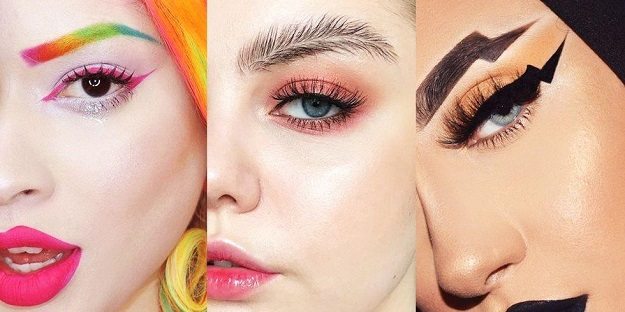
Initially started as a joke trend by popular makeup artist Stella Sironen, the “feathered eyebrow trend”, where half of the eyebrow is glued up and the other half is glued down, took off in a short-lived trend in 2017. It was used in order to “glamorize” makeup and bring it to a new level, although anyone normal would see this and think it was plain odd. Also, it probably is very difficult to make look how it’s supposed to.

3. Using Food for Makeup

Another strange and certainly not skin-friendly trend from last year was using different food items to apply your makeup. The trend, started by Raychel Newton who used a variety of different food objects (mac and cheese powder and Snickers bars to name a few), caused the hashtag #facefulloffoodchallenge to explode, where different makeup artists tried to make a fly look with random food items. While it is most certainly harmless, I don’t quite think it’s good for your skin, and wouldn’t recommend it.

4. Beauty Tampons

Tampons are most certainly not what you’d expect to be used for makeup. But in 2016, beauty blogger Ashley Blue DeFrancesco posted an Instagram video using a tampon as a beauty blender, applying foundation and using it on her skin. Which isn’t too bad, saying that a tampon is an absorbent wad of cotton, but in the context of what it is supposed to be used for, it becomes quite strange. It was surprisingly effective, although I’m not sure you’ll find anyone actively using their tampons to apply foundation, even in case of emergency, anytime soon.

5. Boob Blenders

In 2017, popular beauty blogger Huda Kattan decided to go a very unusual route, and try using a silicone bra insert as a beauty blender. In an attempt to start a new trend, she argued that it didn’t waste product like normal beauty sponges do. However, I don’t know how many people actually own a bra insert, nor do I know how willing they are to cut one up and use it as a blender.

6. Wavy Eyebrow Trend

Finally, we have a trend that some had considered cute, but most had considered bizarre, was the wavy eyebrow trend. Started in 2017, the wavy eyebrow trend involved gluing your eyebrows into “waves”, which some had argued was a new chic. The only problem with it is, that it’s hard to do, looks strange, and is definitely not suited for normal wear. It’s more something you do as a joke, not intend to wear out and about.

The Negative Effects of the “Pure” Trend

I can say that the “pure” trend, a trend where people look for anything and everything to try and argue that some form of media is “problematic” in the efforts of finding the “purest” media, started around 2014. It initially started as a way to avoid promoting people who did shady things, but then evolved and grew much worse, leading to people who follow the trend trying to exaggerate non-real issues in order to say why and otherwise piece of good media was actually awful. The “pure” trend is unnecessarily nasty, attempting to ruin actually good or progressive media.

The most recent case of this was Brooklyn 99Brooklyn 99, which was marked for its genuinely funny humor (and social progressiveness), came under attack for being centered around a police force, which “media purists” argued made the show awful. They discouraged people from watching it, arguing that because it was about cops, it was promoting police brutality (what?). Fortunately, their attempts actually backfired, with people calling them out for trying to ruin a good show.

Unfortunately, this wasn’t the case for a few other examples, particularly Dream Daddy. The game, which is a male dating sim where you have the option of dating many fathers. It was diverse and cute, and it was harmless. However, “purists” jumped on the fact that there was an unused ending for one dad, a priest, where he ran a cult, saying that that ending was homophobic. They extended that assumption to say that the whole game was homophobic, and that the creators, a group called Game Grumps (known for their Youtube channel) were terrible people that deserved to be permanently boycotted. While the game’s popularity did resurface quickly, it took an initial hit, fading to the shadows as the “purists” continued to blast the game.

If you couldn’t tell by the examples, the “purity” trend doesn’t center around conservative Christian values. It’s rather based from the social justice warrior values, the radicalized form of progressiveness. In these values they look to ruin everything to find the most perfect media, which assumes that human beings can be perfect, and any flaws they might have ruin their image for life. These people jump on the idea that someone’s problematic past (in the case that they changed and became better people) makes them unable of redemption, which only reinforces the idea that people can’t change. It completely ignores people’s human nature and variance, placing them in an unachievable position of having to be perfect, always. It’s simply unrealistic and damaging.