No One Wants to Play with a Sore Loser

Playing video games, and games in general, can lead to hours of extreme fun. That is, if you’re not playing with a sore loser.

What is a sore loser? A sore loser is someone who has a nasty competitive streak with anything game related. They can’t just relax and have fun, they have to win, or they won’t stop playing until they do. When they don’t win, they throw a fit and ruin the whole atmosphere. And that’s just if there’s only one person with a competitive streak.

The reason I’m talking about this can all be traced to my winter break from school and two of my younger cousins. I had had problems with these cousins before, as they have a tendency to antagonize each other to the point where it gets out of hand. This antagonizing behavior transfers rather miserably over to video games.

You see, the older brother (who is seven years older than his brother, mind you), has a Nintendo switch, with games such as Mario Party and Super Smash Bros. Fun games, right? Not with them. They are incredibly competitive, especially with each other, bickering and making nasty comments towards each other. They can’t play a game for the sake of having fun. It got to the point where I couldn’t play with them all that much, because their behavior dragged down the rest of the group and make the game stressful. They had to win, and when the younger one got second place in something, he would whine about being a loser that no one liked. Just about myself and all older cousins have called the two out for their behavior, but that didn’t seem to change anything.

Anecdote aside, I think it’s safe to say that no one likes playing video games with overly-competitive people. They make the situation tense, and it doesn’t get any better when they win/don’t win. They suck the life out of playing the video game, and then wonder why no one wants to play with them.

Now, let me just say that it doesn’t hurt to be competitive. Just about anyone can be competitive, which can add to the fun (no one wants to play with someone who doesn’t care enough to try, either). But it’s important to understand that the best way to make that competitiveness work is to understand when a game is just a game, and you won’t lose anything from it (unless you’re winning 10,000 dollars). Overly-competitive people just don’t know how to do that.

The Haunting of Hill House-Paranormal or Just Metaphor?

Beware: Spoilers

Recently, Netflix released a 10-episode series known as The Haunting of Hill House, inspired by the original novel by Shirley Jackson. The show doesn’t center around much of the original plot, however. Rather, it centers around the Crain family (making them the center focus rather than a distant detail), and their troubles in an after the house.

The Crains initially buy the derelict manor in order to flip and sell it, so they could afford to build their own dream home. As time goes on, however, strange things begin to occur around the house, culminating in a “final night” that causes them to leave in a hurry. This night, and life in the house in general, slowly comes together in bits and pieces seen through “character focus” episodes. There is the long-standing mystery of what exactly happened the “final night”, which is solved at the end, but the viewer can’t help but notice that a complex and frayed family dynamic is at the forefront.

Now, throughout the series, there is plenty of the paranormal. There are obvious ghosts, hidden ghosts, even the crazy imagination ghosts. The show lets you know that yes, this is a horror story, making some freaky designs and figures. The ghosts do follow the adult Crain children around, affecting some more than others (Nell and Luke experience the paranormal the most, Steven and Shirley the least). The house has a certain quality about itself as well, seemingly alive and possessive, taking over the minds of Olivia Crain and Nell Crain, and protecting itself against attack. There are multiple levels to the paranormal in this show, providing an especially ghoulish aspect.

In Nell’s episode, however (named the “Bent-Neck Lady”, after the main ghost that haunts her), all this comes into question. Unlike the other siblings, her episode is rife with mental stability issues, as she deals with sleep paralysis, trauma, and anxiety. The youngest Crain’s stable life is ripped out from under her with the death of her husband and a switch to a new therapist. From then her mental health declines rapidly, leading her to enable her twin’s drug addiction and have an argument with her visiting sister. The episode culminates with her returning to the Hill House and committing suicide via dreamlike state , leading to another interesting twist. In the moments before she hung herself, she realized that she had a noose around her neck and she was standing on the edge of a staircase, and got confused and scared. In the moments after, the viewer realizes that she was the “Bent-Neck” Lady, having haunted herself the whole time.

The episode, which works as the halfway point of the series, explains how Nell ended up dying in the house. But it also hints at how the mother, Liv, died in the house as well. Both Luke and the father Hugh blame the house for “killing” Nell and Liv, despite the fact that both were suicides. This could be explained: Nell went into a dreamlike trance, seemingly led by the house into putting the noose around her own neck. As for Liv, she starts seeing ghosts that convince her to kill her family to protect them. From what, is unknown. It’s easy to argue that the house does contain some supernatural capabilities, actively influencing Liv and Nell to their final moments.

However, notice who the house seems to affect. Liv came into the house with an unknown mental illness, marked by migraines that she would get periodically. Her condition was only exaggerated by the fact that Hugh didn’t get the proper help for her, unable to because of stigma against mental illness that plagued the time period. The old house started to get to her, leading her to have sporadic and “possessed” behavior, leading up to her death.

As for Nell, she was also mentally vulnerable, having suffered from trauma and anxiety since she was as young as 6. She was also more prone to being “influenced” by the house, and only was really affected by the house when she was in her most vulnerable state. Luke also, sits in a vulnerable state, and was more prone to being affected by the house due to his struggles with drug addiction.

Also, it can’t help but be noticed that most of the paranormal occurrences occur when the family is divided, following the hill house. Which begs the question-is it really paranormal? Or is it all just a metaphor?

Well, we don’t really know. You could go either way, but you can also say it’s a mix of both. There are shared paranormal experiences among the family, adding a more solid paranormal experience. At the same time, there are individual experiences that are especially tied to mental illness and especially trauma, which solidifies the hypothesis that it’s all a metaphor. All-in-all, it’s never fully explained. Although the cast does like to relate to the metaphor theory, especially as the family is so dysfunctional and traumatized that it would make a great amount of sense.

The Haunting of Hill House is actually a very good show. While it does have its corny shots and moments, it is one that provides multiple layers to its horror, making it perfect to watch in time for Halloween.

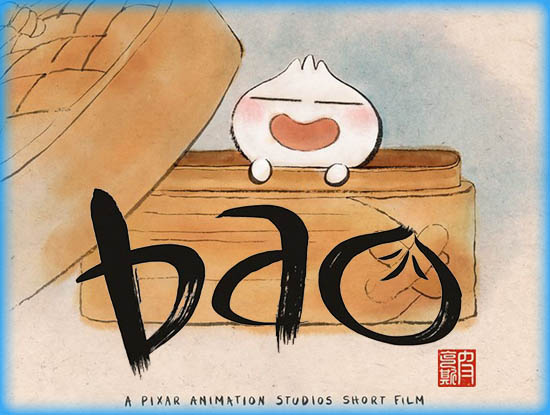
A Month After the Controversy: My Opinion on Pixar’s Bao

Once again coming after all the drama has settled, I have decided to put my two cents in on something. I saw Bao a month ago with my friend, and didn’t think much of it initially. But then all the drama rose and fell surrounding the short, with confusion arising over some aspects of Chinese culture. Is the short worth all the drama? Let’s take a look.

I am going to divide this into three sections: the pros, the cons, and a look at the whole controversy. I’ll try to pinpoint some significant cultural aspects that some people might not understand when looking at this. The analysis here is based off of my opinion, but I’ll try to be factual. This will be spoilery, so if you haven’t seen it and want to, watch out.

The Pros.

What I like the most about the story is the overall message. It was short, and got its story line out without any words. The animation was cohesive and colorful, all the characters being soft lines and not sticking out against the little dumpling child. Everyone was plump and round, and each character was distinctive in characteristic.

I honestly thought the film was a heartwarming tale. I am not quite certain what position the mother is in, but based off of the experiences of my friends’ first generation mothers clashing with them, I imagine there is some influence in there. She clashes with her son, who she sees as acting too far out against her, with the dumpling being a metaphor for her relationship with her son. It really was a powerful portrayal. The short portrays fracturing and reconciliation within a family, with a mother being initially unable to accept her son leaving. It is a story thousands of families face- and it does a decent job at it.

Overall, I thought it was short but had a good story to tell. It was well-animated, and was much better than the last Disney-related short I had to sit through (I’m looking at you, Frozen). I got invested, without needing twenty minutes to do so. It was cohesive and smart, without needing actual dialogue.

The Cons.

I have mentioned that Bao does a decent job at telling it’s story. But it’s not perfect.

The biggest con I can think of for this short is that fact that it relies very heavily on the use of metaphor. Which, works for adults and people who have a concept of metaphor, but not so much for children. In order to explain this, I have to go a little into the plot of the short.

Now, as I mentioned, the dumpling child is a metaphor for the woman’s relationship with her son. She raises the dumpling, but as he grows older he gets more rebellious and distant, eventually trying to leave her. Well, as a resolution, the woman eats the dumpling. Then the son, who looks like the dumpling, steps in from there.

Not bad, right? Well, the problem arises with the fact that most, if not all young children, will not connect the dumpling child as mirroring the son, without really being real. To them, they would see the dumpling child as different, and would think that she actually just murdered a dumpling person. Which, when you think about it, might put kids in distress. And it did-there were reports from audience members of some kids being distressed enough to cry from the scene. The reliance on metaphor is something that most kids-at least the ones that were anything like me-would simply not understand. It’s one flaw, but it’s a big one.

The Controversy.

Now that I’ve given my take, let’s take a look at where the controversy comes from. The short itself was directed by Domee Shi, and was influenced by her experience with Chinese immigrant parents in Canada. And as you can see, you can see the struggles that arise between the mother and the bao as the dumpling grows up and wants to leave and have independence.

How is this a problem? Well, from my friend’s experiences (Korean and Filipino) with their immigrant parents, and from some research, I find that the family and household are very intertwined. The child is not expected to leave the house and suddenly have a career at eighteen-which presents it’s own set of problems in the West-, but are actually expected to stay in the household past eighteen. The family is central, with three or four generations sometimes living in a house together. This idea comes at odds with American culture, especially for the children of immigrants who are surrounded by that culture. It often causes a strain in the relationships (as I’ve seen with some of my best friends and their parents), as the clash in culture causes arguments.

Now, because of my witnessing of these experiences, I am familiar with the cultural clash, especially in Asian immigrant families. However, there were quite a few people (mostly white Americans), who didn’t understand what was happening. This is where the controversy starts. There was an explosion of arguments, as people who didn’t understand the nature and context of the short began social media arguments with people who understood the short all too well. This caused calls of racism and ignorance, when I have to say such sayings might have been a little uncalled for.

Because of social media and the fact that huge portions of the US and Canadian populations live in large, diverse cities, we often forget that there are people who don’t know the experiences of immigrant families, nor understand the context of Asian culture versus Western Culture. When informed, people will grasp it, but when people don’t understand, a pivotal scene like the woman eating the bao would not make much sense. It would just seem like an overreaction to an argument, rather than an important moment that permanently changes the relationship of a family.

Does this mean we should have “dumbed down” the scene for people? No, not at all. While I do think some of the comments I saw were just people who were genuinely confused and not ignorant, I do think some people took advantage to stir up a huge controversy. I don’t think the short should have stirred up that much controversy, but I am not in a position where I understand all sides.