‘Sonic’ Director Agrees to Change Design of Sonic

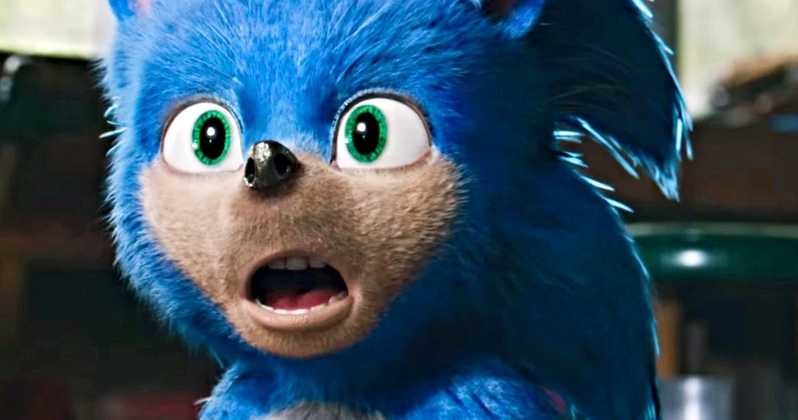
Earlier this week, the first trailer for the new live-action Sonic was released, leading to a wave of criticism from the internet. The model of Sonic that appeared in the trailer was thought to be much worse than what had been seen in teaser posters, with the classic hedgehog looking like a weird fuzzy nightmare with human teeth.

The new trailer led to floods of memes, particularly surrounding the actor Jim Carrey, who is set to play the antagonist Eggman, saying that he will “carry the whole movie”. It also led to many artists editing the Sonic design to appear much more like his classic model from the games, leading to questions of how one artist can make a better design for a character in seemingly a few hours, when a company spent years making a monstrous design.

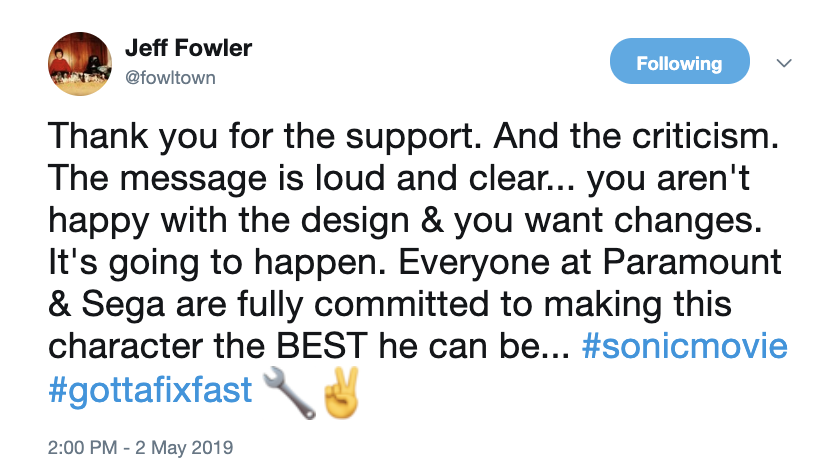
Well, the level of criticism seemed to reach the director, who understood what he needed to do loud and clear. Yesterday via Twitter Jeff Fowler announced that they would be changing the Sonic model to make him appear more like his classic features, which he imagines would appease fans and critics.
The announcement comes just six months before the supposed release date of the film, which excites some, but worries others, particularly artists. The media industry is rife with exploitation for artists, especially as these artists cannot unionize and advocate for themselves. The idea that they would have to change the main character’s model in just six months, with no announced push-back date, leaves the very great and dangerous possibility that these artists will be forced to work overtime for little pay in order to fix the design.

It’s not as though the artists can protest for better work conditions, either. With the media industry being so competitive, these artists can face harsh punishment for pushing back, or even get fired, and be replaced by someone willing to work the hard hours. It leaves the artists in a classic position of either doing what they’re forced to, or find themselves without a job.

The announcement to change the Sonic model comes only a week after developers and artists expose the exploitative work conditions in trying to quickly crunch out new content for the popular game Fortnite.
Why I’m Not Excited to See ‘The Rise of Skywalker’

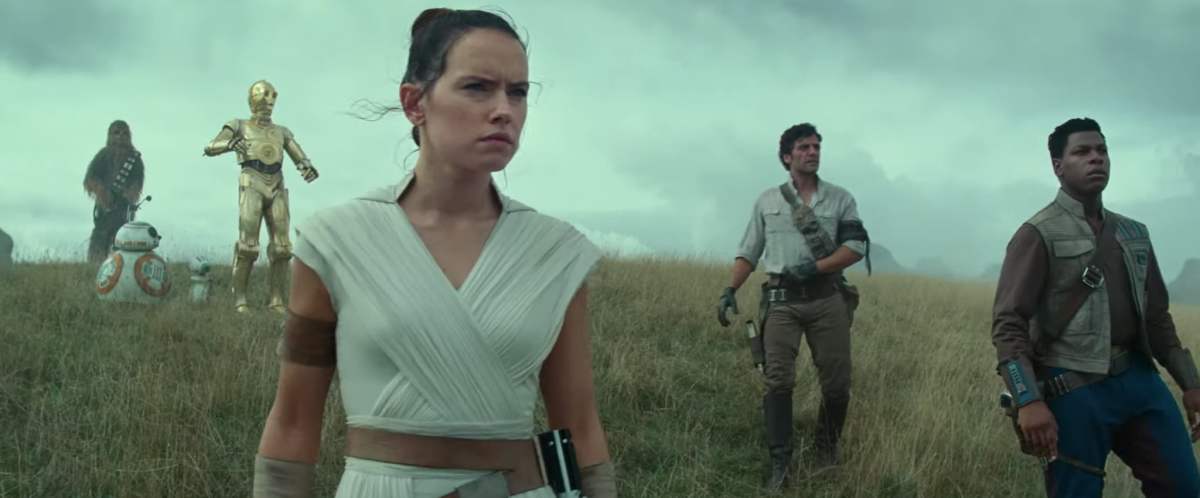
Yesterday morning, Lucasfilms released the newest trailer for Star Wars: The Rise of Skywalker. The trailer has brought about quite a bit of excitement for the film, which is expected to be released December 20 of this year. I can’t say I fall into this same boat.

My disinterest in the newest episode, which will wrap up the new sequel trilogy, isn’t because the jedi is a woman, or there is “too much diversity”, whatever that means. It’s more the fact of just how disappointing the trilogy has been up until this point. The new trilogy, when first announced, had so much potential to be good and unique, and actually bring something new to the Star Wars series, but fell short on so many points.

The biggest problem I saw was just how copy-paste the story line for both Episodes 7 and 8 were. Episode 7, which which kicked off the new trilogy, was mostly taken straight from Episode 4, with a sprinkling of Episodes 5 and 6 in there. It was unoriginal, but the production value and potential that existed in each of characters made it forgivable.

Episode 8, however, was unforgivable. It was literally Episode 5 in reverse, with an attempt at an original plot line that had ultimately no purpose other than to build a half-baked “romantic” relationship between Finn and Rose. It was an unnecessary waste of an entire hour.

The other unforgivable aspect was how they turned Rey into a Mary Sue. For those of you who don’t know what that is, a Mary Sue is pretty much a basic female character that is insanely overly powerful, and is instantly an expert at whatever they do. Rey, who had the potential to become a really good jedi, was wasted as she practically became a master jedi in about two weeks, rather than the months and even years Luke spent training. The jedi, canonically throughout both the original and the prequel series, spend years mastering their jedi capabilities, but apparently that’s not actually necessary cause Rey is suddenly just became a master. It ignores everything that’s been established about the jedi until that point.

Episode 8 as a whole was a pain to watch, and the series is bad for wasting so much potential by being unoriginal in order to “appeal” to people and make money. And its not like it’s because they can’t make original plot lines that are good. They 100 percent can, and did, with Rogue One. It’s just pure laziness. They simply want to push out “canon” content that will make immediate money, and don’t quite care how its done.

The American Meme, and Unnecessary Drama

For the past few days, I had been in a funk about writing. I didn’t have any inspiration to write about anything, which was kind of annoying, because I wanted to at least write about something. That was, at least, until I watched the American Meme on Netflix with my friend last night.

God, this documentary was something else. I don’t think I’ve ever rolled my eyes harder than when I watched this. It wasn’t because the documentary was necessarily bad-just filled with whiny, obnoxious people who complained about being social media influencers, while at the same time refusing to leave it.

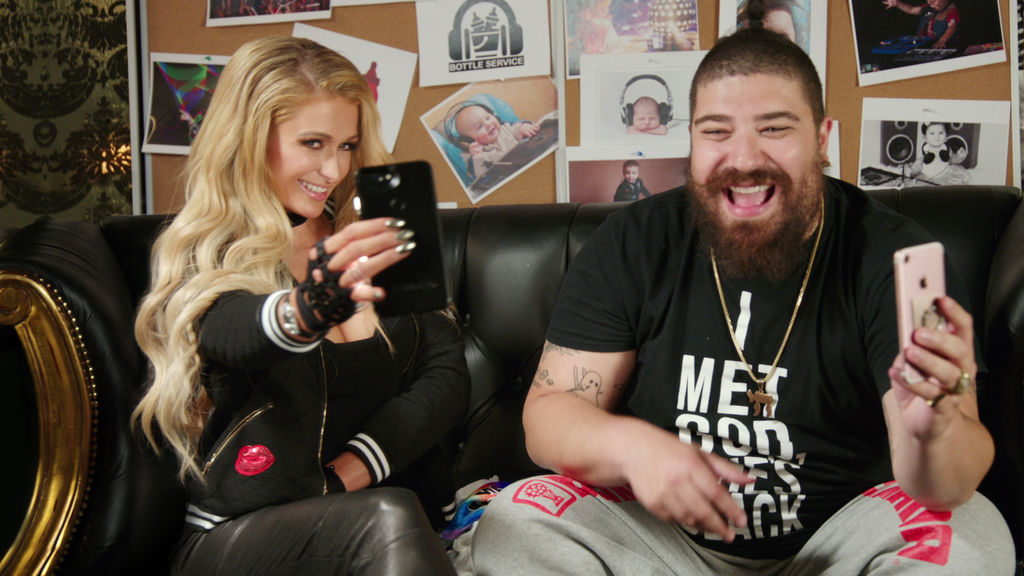
I’m not kidding. Literally ninety percent of the documentary was about these people complaining about being influencers. How they “hate people” or “their life sucks”, but they also continue to do their job because “what else can I do?” The only person I had any real sympathy for was Paris Hilton, who did get chased around by paparazzi, and did have a private sex tape released without her consent. That, I can understand.

But everyone else? I’m sorry, but I have none for them. They’re literally all the same types- kids who move out to LA to make it big, don’t get any parts, and then turn to social media to pay the bills. Then they complain because the pathway they chose sucks and is competitive and fake, but don’t leave or move back home. They claim to be hooked on the attention, which may be true, but seriously, it’s not that hard. Being an influencer is cut-throat. Don’t like it? Leave.

I do realize in writing this that my sympathy may be lessened by the fact that they moved to LA, especially to become actors, which grates on my nerves to no end. I, like most other native Angelinos, hate those kinds of people. The transplants that come here to be in the entertainment industry, then refuse to leave when they get jaded. They increase the traffic, the housing prices, the cost of living. They add to the gentrification of long-standing communities, all the while flaunting how they’re from a small town or some other state. Sorry, but you won’t find sympathy from me.

Another thing that got on my nerves: how these people claimed they had to be crazy to get views, and how everyone in Hollywood dresses up and calls the paparazzi to them now. Which isn’t true in the slightest. Most traditional entertainers (actors, musicians), don’t have the paparazzi coming to them, and don’t get all flashy. They blend into the regular population, eating at restaurants or going to the gym. Most of them stay out of the limelight, going entirely against the claim Mark Henderson made about Hollywood.

And as for social media influencers, I follow plenty of them (and live near a few) that don’t at all do crazy things for the sake of social media. They don’t make fools of themselves, and still get millions of views on a youtube video they release, or an Instagram photo that they send out. This documentary tries to say otherwise, but facts are facts.

This documentary, to a certain extent, was a load of bs. I won’t lie and say that social media is nothing like this (because any creative platform can be pretty cut-throat and strenuous), but the extent to which these people make their claims is so exaggerated. The people interviewed also act like there’s no way out, but then contradict themselves (like Kirill was saying he had ‘no other option’ than to party like crazy for Instagram, and then it goes and talks about how Paris Hilton used her fame to start a bunch of brands), to the point where is just seems ridiculous. To me, the documentary was just a way for people to complain about their lives without actually changing anything about it.

The Saturation Complex of Geek Culture

I had mentioned in a post earlier that there is a prevailing idea that misconstrues how geek culture came to be. I can’t really say where this came about, although I strongly suspect that films and TV shows of the 1970s and 1980s paired with gendered conceptions surrounding geek culture are to blame. Whatever the cause, it has fueled this conception, leading to a sort of alienation complex as the geek community shifts and changes.

As a result, there is this saturated version of history, which relies on the idea that women and minorities have not been a part of geek culture until very recently (as in, within the last decade). As a result, there has developed a constant push against women and minorities joining in on geek culture, with particular “tests” placed against women in order to test if they’re “qualified” to partake in the geek community. These blockades grow increasingly pointless as geek culture continues to gain popularity, and yet for some reason persists. Perhaps I can explain why.

You see, it all starts at the source of geek culture: Science Fiction (Sci-Fi). In the saturated version of geek history, the first Sci-Fi author was Jules Vernes, best known for his book Twenty Thousand Leagues Under the Sea. As a result, this causes men who believe this start to think that women and other minorities have no real right to enter and write about Sci-Fi.

However, if you make one quick Google search, you’ll find that this version is incorrect. While Jules Verne was one of the earlier Sci-Fi writers, the real first Sci-Fi author was Mary Shelley, who published Frankenstein in 1818, a whopping fifty years before Jules Verne. This makes the Sci-Fi genre not a “boys only” club, but a club founded by women.

Shelley wasn’t the last female Sci-Fi author, either. Well-known ones include Octavia E. Butler, Margaret Atwood, Ursula K. Le Guin, and Suzanne Collins. Sci-Fi has never been a “boys only” club, although it is often pushed to appear that way.

Comics, by contrast, didn’t really diversify until recently. In its early days, the comic industry was very much “boys only”, mostly outright refusing to hire women and other minorities. This isn’t unusual, however; the entertainment industry as a whole was that way.  That isn’t to say that women and minorities weren’t in those realms, but it was very difficult to break in, particularly from the 1920’s-1970’s. This realm makes it a whole lot easier to promote the saturated history. Since women and other minorities were barred, it was easy to say that they didn’t belong and exist in the space. Despite the fact that the majority of comic readers in the present era greatly outweighs the “traditional” readership (white men), there is still this stigma that pushes women and minorities away.

The same goes for the video game industry. Women and minorities were mostly barred in the early days (as they were discouraged and stigmatized from getting STEM degrees in college), meaning that they couldn’t break in until more recently. This has created a frictional environment that extends beyond game development and into game playing, leading to online harassment and common claims of not being a “real gamer” to anyone that doesn’t fit the geek stereotype. To be honest, the “fake gamer” argument is ridiculous: if you play games, you’re a gamer. You don’t have to be best of the best, but if you play video games as a hobby, then you qualify.

The reason there is such a push back against diversity entering geek culture mostly stems from a victim complex among the “traditional” geeks. Despite the fact that geek culture has been gaining continuous popularity over the last two-three decades (exploding after the premiers of Walking Dead and Game of Thrones), the news for some reason has not hit the geek community. Or, rather, it has not processed.

The “traditional” geeks seem to be in denial about just how popular geek culture is, moaning and groaning how they are such victims and such a minority, while at the same time fighting against anyone that doesn’t fit their own characteristics and pushing them away. They like to act like they’re still the kids that get severely bullied, although just about any kid with a computer nowadays has access to video games and anime. It’s a bizarre complex that sticks out like a sore thumb.